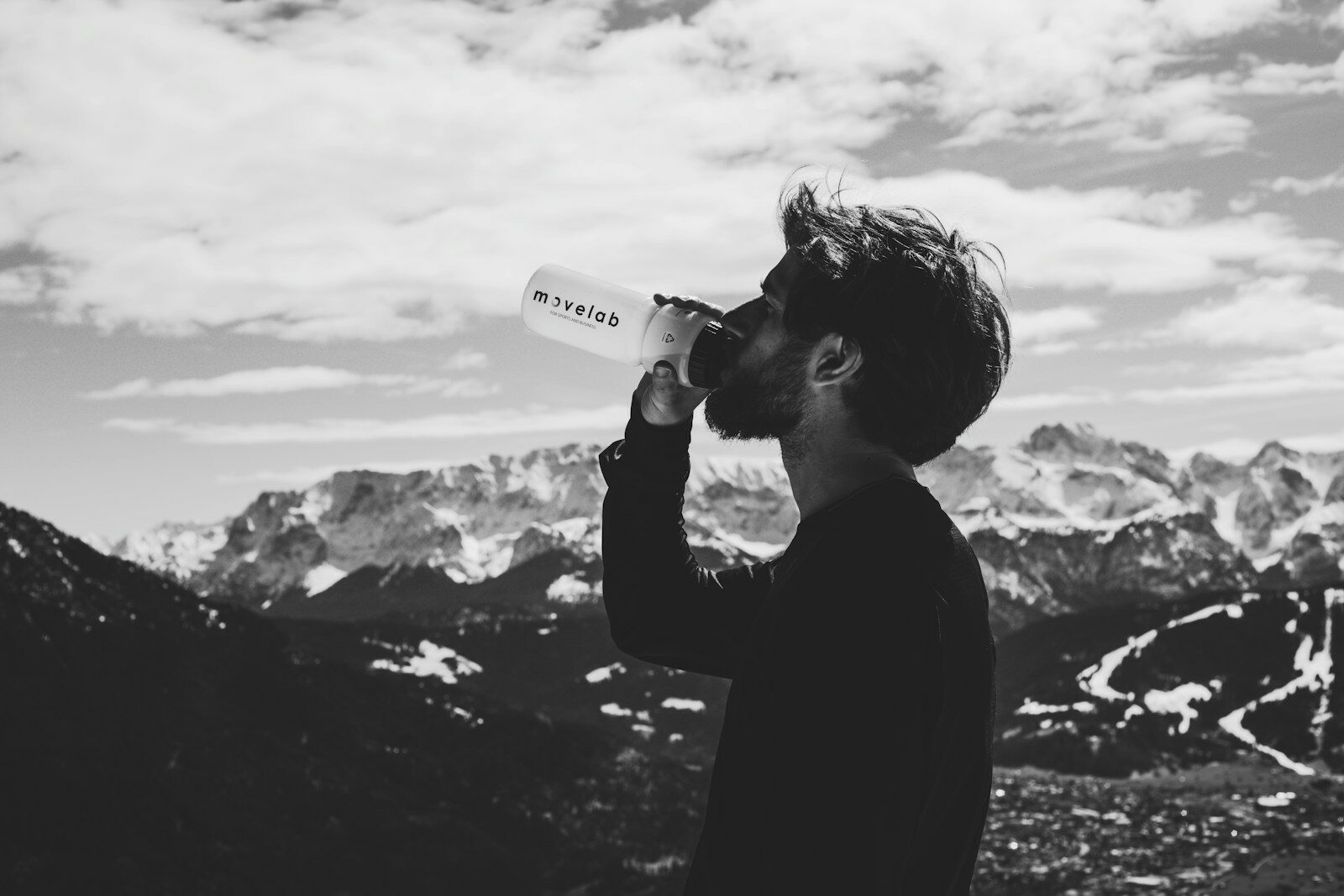
Do you drink enough water when it’s cold out? Are you sure?
An average winter day can be more strenuous than a typical spring or summer day. Just getting out of the house can take core strength and burn up some calories. There’s snow to trudge through, shovel, and clean off your car.
All that drying air, wind, and indoor heating.
Sauna sessions, skating, skiing, and other winter fun.
And there’s something curious about how our bodies respond to cold, dry air, and other winter conditions. Cold weather is shown to thirstiness by up to 40%, while increasing how much fluid your body uses and loses – from respiration, urination, and other biological processes.‡
If you aren’t careful, you could end up super dehydrated and more susceptible to a scratchy throat, flaky skin, and other winter conditions.
☃️⛷️🏂🛷❄️
Cold weather makes us pee more (like twice as much) but not want to drink
It all starts with peripheral vasoconstriction.
The body responds to cold weather by sending more blood into the core, to keep those vital organs warm. It does this by constricting the blood vessels in the extremities, then redirecting that blood to the core.
But this has recurring effects.
- The central blood volume & blood pressure increase.
- The central volume receptors tell the brain that it’s full of fluid.
- The body thinks it’s more hydrated than it truly is.
- The brain decreases thirst sensations and lowers a hormone that regulates water retention – arginine vasopressin (AVP).
- The kidneys respond to high blood pressure by filter out that “extra” fluid and the sodium that’s concentrated in it. (You pee more.)
The peeing phenomenon is officially called cold-induced diuresis – a phenomenon where people can urinate more in cold conditions than in heat. Research shows it can be up to twice as much and it occurs even when people are dehydrated. [1] [2]
This cold weather response doesn’t just increase urination, it also decreases thirst.
Researchers had 8-9 men exercise in cold vs temperate environments, while being either underhydrated or at normal hydration. This study found that cold exposure reduced thirst by up to 40%, whether the men were at rest or exercising. And it wasn’t even super cold – only about 4° C or 39.2° F. [3]
Cold itself can lower the sensation of thirst
You might already know that humans don’t have specific “wetness” sensing receptors. The perception of wetness and humidity comes from feeling a blend of coldness, pressure, and texture – then using prior experiences to interpret those sensations. [4][5][6]
This carries over into how the body detects fluid ingestion, which then impacts how it regulates thirst.
The brain interprets a cooled throat as having been refreshed with a nice, cold drink. It then moves to prevent overhydration by turning down the thirst levels – even if you didn’t drink a single sip.[7]

The brain’s neurons anticipate the effects of eating and drinking. Sometimes they get things wrong.
Thirst is partially regulated by the brain’s subfornical organ (SFO). The SFO’s neurons detect sensations coming from the oral cavity, like coolness, then uses that information to regulate thirst.
These neurons stop firing when they detect fluid ingestion (i.e., detect the coolness related to fluids), but they also stop firing when the temperature drops from other causes. This mechanism is why drinking a glass of cold water can quench thirst before the water absorbs.
It’s also why simply cooling the mouth and throat can suppress thirst, even if you didn’t drink anything.[8][9]
Why our bodies link coolness to fluids
Not only do we not have wetness sensors, but we actually learn to perceive wetness by experiencing it as infants. Our skin’s temperature drops when water evaporates from the surface, so we associate cool sensations with wetness.[6]
It’s kinda weird for our bodies to think cold = wet, but our strong association between coldness and hydration might also originate as an evolutionary safety mechanism.
Out in nature, cold running water is so much cleaner and safer than stagnant warm water. Water that’s colder and more aerated is likely to be from an underground spring, melted glacier, or other crisp clean source. Anything warm, still, or stagnant could’ve been sitting around breeding all sorts of bacteria.
Whatever the cause, our mouths, throats, and upper airways contain TRPM8 receptors which detect cold temperatures, from drinks, the air we breathe, or even menthol candies.[10]
The brain interprets TRPM8 signals as hydration. And to this day, we’re wired to think that cold = fluid, cold fluids are more refreshing and hydrating than room temperature ones, and sparkling cold drinks are absolute top-tier. 🙌

Sweating can go unnoticed in winter
Hot and sticky summers aren’t the only time you sweat. You sweat in winter as well, but you usually can’t tell. That’s because winter air is sooo dry it rapidly absorbs moisture from your skin – causing something called “insensible perspiration”.[11]
So winter results in invisible sweating (unless you get totally drenched doing sports or something). But it also brings lots of reasons to perspire.
- The body perspires to keep the skin humid. Then the perspiration instantly evaporates into the dry air, leading your body to perspire more.
- Winter exertion is real. Trudging through snow, shoveling, and clearing off cars is serious work.
- Layers, layers, layers. You’re definitely going to sweat under all those layers,.

Just breathing winter air uses extra water
Cold air is dry air, but our breath is warm and humid. This creates something called the “water vapor pressure gradient,” meaning that our breath is more saturated with water vapor than the winter air is. And since water vapor pressure seeks to equalize, the water in our breath evaporates when it hits cold dry air. [12][13]
This happens in a loop. Our bodies warm and moisten the air we breathe in. Then as we breathe out, the water in our breath evaporates in the dry winter air. The colder and dryer it gets, the more water we lose. Indoor air isn’t much better, since artificial heating dries it out.
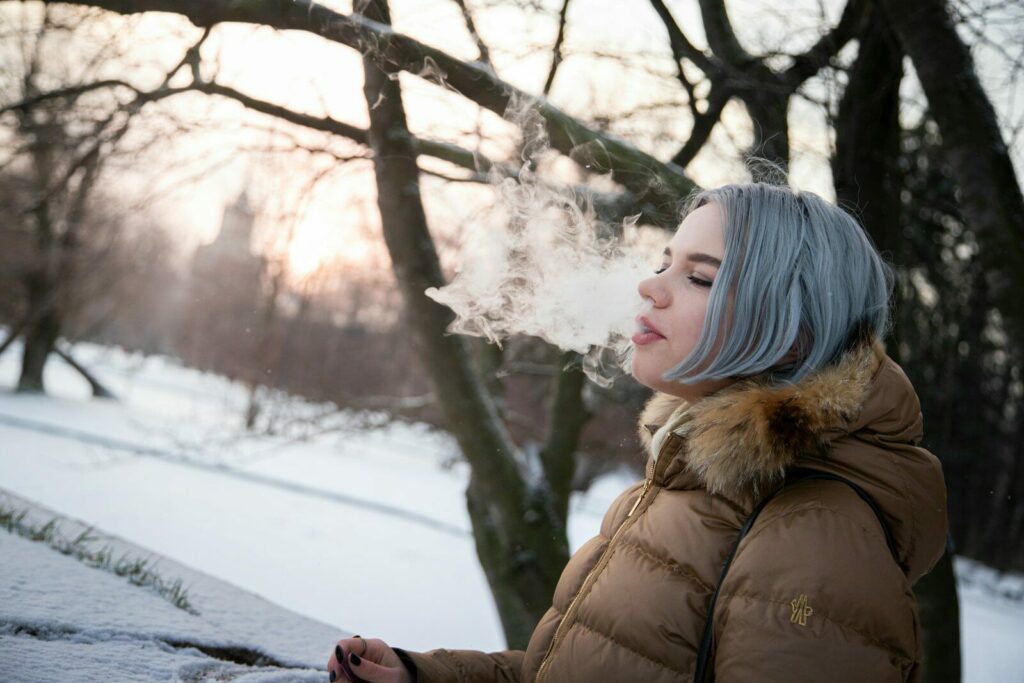
The amount we lose might not be super high, but it can creep up there with coldness, altitude, and exertion levels.
In temperate climates, normal water vapor losses are around 200 to 350 ml per day for sedentary people and 500 to 600 ml per day for active people. Military studies adds 300 ml for cold weather. Altitude alone can add another 200 ml per day in water losses. High altitude fitness⛷️ can see respiratory water losses of up to 1,500 ml of fluid per day. [14] [15] [2]
Here’s the thing: ventilation volume matters – aka how much you’re breathing! [16]
Breathing fast and hard jacks your water use up. So, would you huff and puff faster than a trained soldier? Then up your water intake.
Drinking water is less appealing when it’s cold out
When we’re cold, our core drive isn’t to hydrate – even if we need to. We’re programmed to focus on warmth first, then food.
Research shows other animals, like rats and dogs, are like this too. Cold rats want to get warm, stay warm, and find food and will avoid drinking water even when dehydrated.[17]
As humans, we have added psychological concerns that can inhibit water intake. We can resist drinking to avoid getting even colder and we’re more likely to wear tight, bulky, or layered winter clothing that’s hard to get off.
Why intentional winter hydration is so important
Hydration is a true winter wellness ally.
Staying hydrated replenishes the skin, oral cavity, and nasal passages with water; preventing scratchy throats, flaky skin, and other common cold weather complaints.
It primes the immune system, helping the body fight colds, flus, and winter bugs.
It restores the water lost from cold-induced diuresis (increased urination).
It can displace excess food consumption and prevent winter weight gain.
But cold weather confuses our biological programming – so it miscalculates hydration levels, suppresses thirst, and focuses on other things.
- Cold weather increases urination – up to twice as much, even if you’re dehydrated.
- Cold weather suppresses thirst – physiologically and psychologically.
- Breathing in cold climates uses up more water in insensible water loss.
- Dry winter air pulls moisture from the skin.
- Artificially heated indoor environments are just as drying as the outside.
- Winter exertion generates more sweat.
- Sweat evaporates faster in cold temperatures – making it harder to detect how much you’re losing.
So it’s safe to say that staying hydrated in cold weather is super important – even if you don’t feel thirsty.
Tips for staying hydrated in cold weather
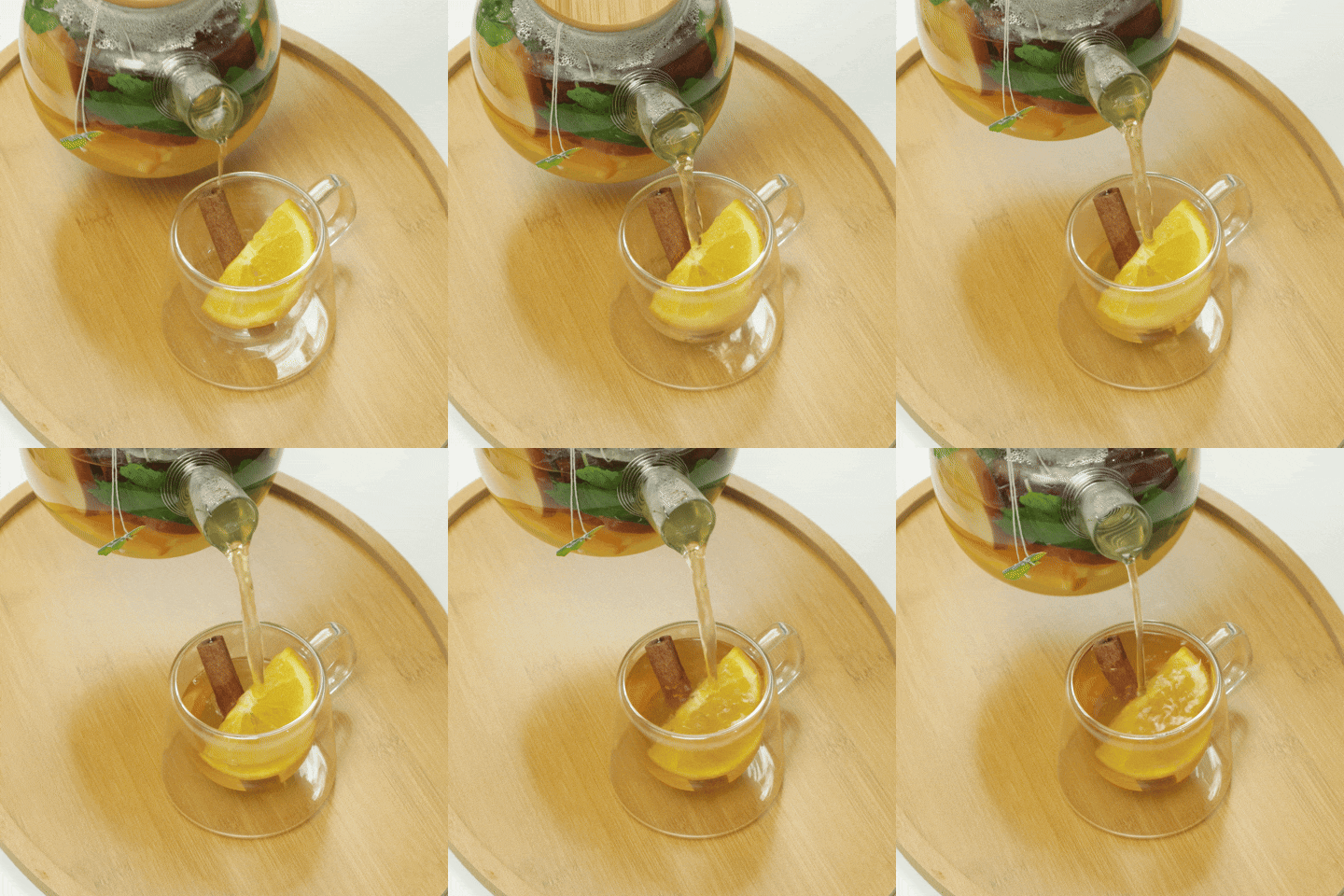
- Keep water within reach
- Drink warm beverages, like caffeine-free teas and lemon infused hot water
- Bring water or tea when you’re going outside
- Sip water throughout the day, even when you don’t feel thirsty
- Add electrolytes to replenish salts
- Program reminders into your phone
- Eat water-rich foods, like soups and broth
- Track how much water you drink when exercising
One last sip
You might feel less thirsty in cooler temperatures, but your body is still losing a lot of water.
You lose water from breathing dry air, insensible perspiration, and normal biological processes.
The cold alone can make you pee twice as much. Your body sweats just to maintain normal skin humidity. A crisp autumn walk pushes losses up. Getting real active demands even more.
Thirst alone isn’t a good hydration tracker because cold exposure suppresses those feelings.
Drink up, keep sipping, and track your intake.
17 This Post Cites
1. ScienceDirect, “Cold-Induced Diuresis,” [Online]. Available: Open source
2. D. D. Army Department, “Water Requirements and Soldier Hydration,” [Online]. Available: Open source
3. R. W. KENEFICK, M. P. HAZZARD, N. V. MAHOOD, and J. W. CASTELLANI, “Thirst Sensations and AVP Responses at Rest and during Exercise-Cold Exposure,” 2004. [Online]. Available: Open source
4. Luis Villazon, “How do we know when something is wet?,” 2015. [Online]. Available: Open source
5. Neuroscience News, “Why Wet Feels Wet: Understanding the Illusion of Wetness,” 2014. [Online]. Available: Open source
6. “Why Can’t I Tell if Something is Wet or Cold?,” [Online]. Available: Open source
7. C. Peyrot des Gachons, J. Avrillier, M. Gleason, L. Algarra, S. Zhang, E. Mura, H. Nagai, and P. A. S. Breslin, “Oral Cooling and Carbonation Increase the Perception of Drinking and Thirst Quenching in Thirsty Adults,” 2016. [Online]. Available: Open source
8. Christopher A Zimmerman, Yen-Chu Lin, David E Leib, Ling Guo, Erica L Huey, Gwendolyn E Daly, Yiming Chen, and Zachary A Knight, “Thirst neurons anticipate the homeostatic consequences of eating and drinking,” [Online]. Available: Open source
9. “Duke researchers discover hidden mechanisms behind physical, chemical cold sensations,” [Online]. Available: Open source
10. T. Y. Hiyama, “Understanding of Thirst in Medical Science,” 2025. [Online]. Available: Open source
11. “Cold Environments – General Occupational Health,” [Online]. Available: Open source
12. “Weatherwatch: cold air risks dehydration so drink more,” 2019. [Online]. Available: Open source
13. “When air is inhaled, it quickly becomes saturated with water – Knight Calc 5th Edition Ch 19 Problem 41,” [Online]. Available: Open source
14. “Dietary Reference Intakes for Water, Potassium, Sodium, Chloride, and Sulfate,” 2005. [Online]. Available: Open source
15. Institute of Medicine (US) Committee on Military Nutrition Research and Bernadette M. Marriott, “Water Requirements During Exercise in the Heat,” 1993. [Online]. Available: Open source
16. D. R. Brebbia, R. F. Goldman, and E. R. Buskirk, “Water Vapor Loss From the Respiratory Tract During Outdoor Exercise in the Cold,” 1957. [Online]. Available: Open source
17. “Cold Weather Increases Risk Of Dehydration UNH Study Gives Insight Into Why We Feel Less Thirsty,” [Online]. Available: Open source